A Possible Story
My mother's name was Ruth Mildred Ursel and she descended from Germans. Her father, Adam Ursel from Reichau in Galicia and on her mother's side, Rumpel and Uhrich who had emigrated from Bukovina which was, in the day, part of Austria. It was re-populated in the late 18th century by Germans who were brought in to farm the land and to provide other skilled labour.
"Following the Austrian take-over, the Hapsburg emperors began recruiting experienced farmers, craftsmen, miners, glass workers and foresters to settle the area. Joseph II published the Patent of Settlement in 1782 promising eligible immigrants free transportation from Vienna to their new homes, a house with a garden, fields, draft animals, no taxes for the first 10 years and exemption from military service for the eldest son. Several thousand Germans emigrated from southwest Germany (Baden, Württemberg, the Palatinate), Bohemia and the Zips mountain region of what is now Slovakia". (Read: The Bukovina Germans in Lewis County, Washington by Mary Lee Rose, 1996)
Today this region is split between Ukraine and Romania and is no longer known by it's former name. As land became scarce towards the end of the 19th century and also due to increasing political tensions, her ancestors moved on - to Canada and other places including England, Germany, USA, South America and also other parts of Europe. The known history goes back into the 1500s, in Germany. Our earliest proven ancestor on the Ursel side being Peter Urich, born in Hüttenthal, located in Hessen, Germany in 1390.
The story of our Ursel family in Canada, begins in Winnipeg. It is a complicated tale which includes numerous characters and locations all over The Prairies. The story takes place over the early part of the 20th Century. Benjamin Ursel is the first to appear in Winnipeg in 1903. He had found his way to Winnipeg after having travelled from Central Europe by whatever means he could afford including a long, arduous and probably expensive passage by ship to the New World. He worked for the CPR, at the time and boarded at 498 Stella. His next appearance in the directory is not until 1916. He works for Michael Ert Ltd. as a batteryman until 1918. There is also a Benjamin Ursel who works as a bookbinder in 1923. It is not known if he is the same person. It is also not known if Benjamin married or had children.
The next man to be listed is Philip. He is also present in 1903 but not at the same address. He lives at 65 Kate. This would indicate that Philip may not be related to Benjamin although they share the same family name. Philip moves around several times and he has a number of occupations and employers. He does manage to build himself up to Foreman at Canada Packers and then Department Foreman before he takes a job as Foreman at the Sask Co-op Creameries. He marries Margaret.
The following year, 1904, there appears a Karl (or Carl). He works for the CPR and lives on Logan Av. W. He sticks around until 1913. His occupation is listed as either Ash Pan Maker or Boilermaker. This would indicate that he was trained in sheet metal fabrication before he came to Canada. Again, Karl's address is different from either Philip or Benjamin. Again relationship is unknown. The origin of these men and therefore their language is also not known at this time but it is most likely German. They do not appear to have had children. In 1905, a Charles, a Henry Sr. a Henry, Jr. and a Samuel arrive in Winnipeg. The two Henry's and Samuel live at the same address. It is likely that they are related. While not at the same house, Charles has a similar occupation, Ash Pan Maker, and does appear to be related. Another man, Fred shows up, at the same address, in 1909 or 1910. One can never be sure of precise dates. He works for Manitoba Iron Works as a “Rivet Boy” before starting his job as a sheet metal worker. He doesn't stay long, however, as he moved to Pleasanton, Texas in 1916 and appears to have spent the rest of his 77 years as a tinsmith having established his business there. His obituary, in the Winnipeg Free Press on Sep 17, 1970 states that he died on the 15th leaving his wife, Elsie. He also had a brother, Alfred, in Alaska, two daughters - Mrs Lena Knuchok of New Jersey and Mrs Ruth Palmer of San Antonio, Texas and two grandchildren. He was also survived by two sisters, Lena and Minnie. He was predeceased by three brothers, Charlie and Gustav of Winnipeg and John of Chicago. The Charlie mentioned in the obituary may be the same man as was mentioned earlier.
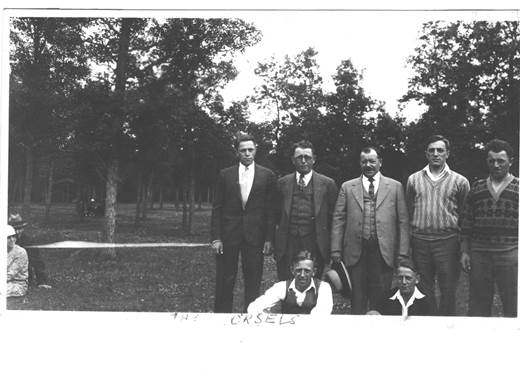
1 The Ursels: Adam Sr flanked by six sons: Adam, Charles, Frederick, Gustave, John and Jakob (Jack) (not in order)
Jacob (Jack) is a bookbinder and, over the next 15 or so years, takes several jobs using this skill. At the same time, Frederick begins his long career as a tailor. He begins by working for a number of local tailors. Geo. Clement & Son, Durant & Stanley & A. Vespers to name a few but he eventually sets out on his own. He shares his home with Adam (Jr., my grandfather), John, Gus, Jack and Hermann (although he is not shown here we know he exists) and, later on, Fred Jr., Brian, John G. (Lillian), Susan, Marion and Rick. He apprentices at least two of his sons, Fred Jr. and John in his trade. As a result of careful planning, the business prospers and firmly establishes as Tru-Fit Tailors eventually under the guiding hand of John and Lillian. This type of record, as a directory, is occupation centric so, with the exception of Lillian, little mention is made of any women. There is also no mention of a father (Adam Sr. ) to this brood.
In 1909, Jacob and another Frederick came to Winnipeg. Since there is also a John listed with the same job, it might be possible that Jacob and this John are the same man. I say “this” because there is another John who works as a carpenter. Sometimes, when immigrants came to Canada, there was some confusion as to how they were to be named. Names do not always translate directly and how they end up being translated is often at the discretion of the translator. This also may have happened with Karl (Carl, Charles). The British with their compunction to "anglicize" names often meant that Europeans were given, or accepted, poorly translated names.
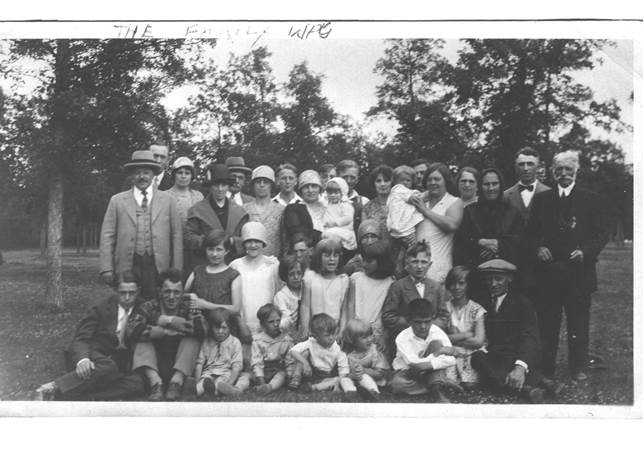
2 The Family, Winnipeg: A Sunday outing?
This photograph of Adam, Sr (Panama hat, far left) along with the rest of the family, so we know he was present at least at one time probably around 1918 or 1919. In total, there are 36 individuals in this photo. The reader will also note two older people at the right side of the picture, in black. It is believed that these are Grandfather and Grandmother Koch, parents of Karolina who is Adam Sr’s wife. She is probably the woman standing to the left of Adam Sr, in the really nice coat and hat. There are Adam's sons also in this picture but the rest remain unidentified. Adam Sr, five of his sons and probably Georg Adam Koch are in this picture. So, who are five other men who aren't in the above picture (#1)? Judging by the movement and expressions, the children have grown tired of this rather traumatic scene.
Taking a picture in 1918 was not like taking a picture today. Maybe a picnic day in Selkirk Park, maybe it’s Sunday just after Church or maybe it’s about to rain. These people may have been poor but that did not mean that they didn’t dress well. Most notable features of this photo, apart from the fact that it exists at all, are superbly tailored suits at least on Adam Sr. and Frederick, probably made by Fred, and Adam Sr’s Panama hat which he obviously treasured. Also Caroline’s coat. The notation at the top is probably Stephanie’s and the photo was probably taken by Adam Jr. since he is not in the picture. See below for a note on the historical context of this picture.
Adam Jr. was working for the Dominion Exploration Co. starting in about 1914. Soon after this photo was taken, in about 1920, he moved to Cupar, in Saskatchewan where he worked as a mechanic (1921 Census) and then to Regina where he met my grandmother, Stephanie. Later, Gus also moved to Regina.
There are other Ursels too. There is Henry, who works as a labourer and caretaker, Park Supervisor for the City of Winnipeg and Peter who works as a shipper, warehouseman for local produce companies. There is also Barbara, who works at the Winnipeg Casket Co. before working as a Stenographer and Registrar.
At the end of WW1, there are at least 7 and possibly up to 12 Ursel men in Winnipeg.
There are quite a few more Ursel's who emigrated to Canada including a Bernhardt who was living in the East Kildonan region of Manitoba (1916 census) and a Henry with his wife and four children living in the Municipality of Lansdowne (1916 census). There is another Jakob Ursel found in Central Butte, Sask as well as John Ursel in Brandon shown living there in 1931. Besides these, there is a John Ursel on Regent St in Winnipeg who is shown living with his wife, Annie. There is yet another Adam who is a blacksmith in Glenella, Manitoba. A couple of these men may have moved around such as Frederick T Ursel who is in Weyburn and a Henery Ursel in the Village of Buchanan, Sask (1921 Census) There is a Jacob Ursel living at 361 Charles in Winnipeg also in 1921 with his wife Caroline. There is a Philip Ursel together with his wife, Margaret and four children in St Boniface also in 1921. This Philip had lived in Winnipeg but moved to St Boniface. There is also a Jacob Ursel just northwest of Edmonton and a bit southeast of St Albert in Alberta who had received his land grant of 'one hundred and nineteen and thirty one hundredths' acres in 1895. As far as I know Jakob is not related to us. There are also Ursel's who had migrated to British Columbia, again not related to us. In the states, there are Ursel's who went to Kansas and a Ferdinand Ursel who was born in Berdikau, Galicia, son of Jakob born in Rehburg, who is found in Johnstown, Pennsylvania. With all the Ursel's we know about in the late 19th to early 20th century, there could easily be hundreds alive today.
Similar to other surnames, the Ursel surname can take several forms including: Ursell, Urschel, Orsel and possibly others.
As was stated earlier, many people had fled eastern Europe due to political unrest. But unrest also happened in Canada too as with the labour and farmer unrest that led to the 1919 strike. Historically, this was a really big deal and became a pivotal moment in Canadian history.
The Winnipeg General Strike – Encyclopedia Britannica
During the war, discontent had increased in virtually every region of Canada and in almost all of its social classes. When the fighting ended, patriotic constraints on demands for change disappeared, and organized labour and farmers mounted a revolt that swept across Canada. In 1919 the Conservative government of Ontario was turned out by a farmer-labour alliance led by the United Farmers of Ontario. United Farmers governments were elected shortly afterward in Alberta (1921) and Manitoba (1922). In federal politics the agrarian-based Progressive Party in the 1921 election became the second largest party in the House of Commons. The agrarian revolt was marked by demands for farm price supports and regulation of the grain and transportation industries. At heart, however, it was aimed at curtailing the growth of the power of the cities.
A labour revolt paralleled the uprising on the farms. The virtual doubling of union membership across Canada during the war and the failure of the Borden government to control inflation stimulated militancy. There was an upsurge of industrial unrest despite governmental efforts to impose peace. In 1919 the unrest peaked with a six-week general strike that paralyzed Winnipeg and sparked sympathetic strikes across Canada. The Winnipeg General Strike was crushed by a federal government gripped by a hysterical fear of revolution. By 1921 the labour revolt had subsided, partly because of federal intervention and partly because of the onset of an economic downturn that brought increased unemployment and a virtual collapse of union power.
It is also important to bear in mind that these events occurred on the tail of a Worldwide pandemic not unlike what we have recently experienced. This, no doubt, was also a cause of much of the unrest.